How Sitegravity measures AI visibility
Sitegravity measures how AI assistants recommend your brand across Asia's languages, and shows you what to fix first.
How it works
- 1
Choose your brand and competitors
Your market, your industry and up to three competitors you want to compare against.
- 2
Ask in the languages your customers use
We write the questions real customers ask — with places, budgets and situations — separately in each language, not as translations.
- 3
Repeat across six AI engines
Every question is asked several times on six AI engines (Doubao and Yuanbao run Chinese prompts only), because AI answers vary from one attempt to the next.
- 4
Get a report and priorities
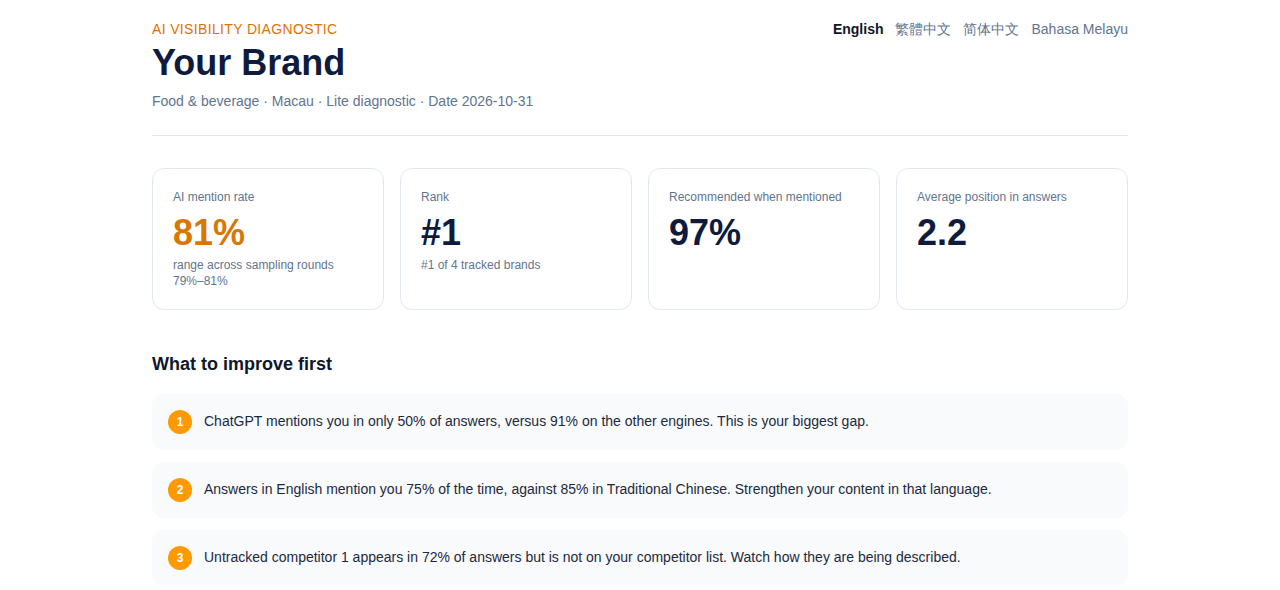
You receive your mention rate against competitors, where you are weak, and what to improve first.
What the report contains
Mention rate and peer comparison
How often AI names you, against the competitors you track, with the range across sampling rounds.
Differences by engine and language
Where you are named and where you are invisible, engine by engine and language by language.
Competitors AI recommends that you did not list
Businesses of your type that AI names often, including ones you were not watching.
The websites AI cites most
The sources AI relies on when it answers, and whether your own website is among them.
Language comparison
For parallel tests: how much the recommended lists change when the same question is asked in another language.
Priority recommendations
A short, ordered list of what to improve first.
Engines and search sources
We ask six AI engines through their APIs — four international and two from China. Every engine except Doubao runs its own web search, and the source of that search differs.
| Engine | Search source |
|---|---|
| ChatGPT (GPT-6 Luna) | The provider's own web search |
| Gemini (3.6 Flash) | The provider's own search (Google Search grounding) |
| Perplexity (Sonar) | Search built into the model |
| DeepSeek (V4.1 Flash) | Third-party search (Exa), not the provider's app |
| Doubao 豆包 (Seed 2.1 Turbo, no web search, reflects the model's own knowledge) | No web search, so not comparable with engines that search the web; Chinese questions only. The app's free tier is 2.1 Auto / Lite; the international API has no Lite version. |
| Yuanbao 元宝 (Hy3) | Third-party search (Exa), not the app's search; Chinese questions only |
Yuanbao (China's AI assistant) is measured through its API with third-party search, and Doubao through its API without web search (its results reflect the model's own knowledge); both with Chinese-language questions only. The apps also use exclusive content such as Douyin, Toutiao and WeChat official accounts, so results differ from what people see there — see Method. Models change as providers update; the model stated in each report applies. → Method
Languages by market
Every diagnostic runs in English, Simplified Chinese and Traditional Chinese, plus the local language of the market where there is one.
| Market | Languages tested |
|---|---|
| Malaysia | English, Simplified Chinese, Traditional Chinese, Malay |
| Malaysia — medical tourism | The four above, plus Indonesian |
| Macau | Traditional Chinese, Simplified Chinese, English |
Lite and full diagnostics
| Lite | Full | |
|---|---|---|
| Questions per language | 3 | 12 |
| Sampling rounds per question | 3 | 5 |
| Typical use | A first snapshot — the free diagnostic | A full baseline before monitoring or consulting |
See where AI stands on your brand
Request a free diagnostic. We reply within three working days, and deliver the report about a week after your brand and competitors are confirmed.
Get a free AI visibility check